Surveys: Gather structured data and open text feedback in one place
Team Askable
•
February 3, 2026

•
Surveys have become one of the most versatile and scalable ways to understand what people think, feel, and do, especially when teams can gather structured data and open text feedback in a single, unified workflow.
Surveys today are far more powerful than the static forms many people remember. Modern organizations need insights that combine quantifiable metrics with rich qualitative context, and surveys are uniquely positioned to deliver both. Structured data provides the measurable signals that help teams compare trends, spot patterns, and track sentiment over time. Open text feedback brings depth, emotion, and nuance that numbers alone cannot capture. When these two elements come together in one place, researchers and product teams gain a complete, holistic understanding of user attitudes and behaviors. This blend of data types is becoming essential in a world where user expectations shift quickly and decisions must be grounded in evidence.
The dual role of surveys is especially important as AI, automation, and digital experiences reshape how teams collect insights. Structured questions allow for precise measurement, from multiple choice selections to opinion scales that reveal the strength of a participant’s viewpoint. These metrics help teams benchmark performance, compare audiences, and track changes over time. On the other hand, open text questions give respondents space to articulate experiences in their own words. This qualitative layer uncovers the why behind quantitative patterns, revealing motivations, concerns, and emotional drivers that would otherwise remain hidden. Together, these elements create a richer understanding that supports smarter, faster decisions.
To maximize value, modern survey design prioritizes a fluid experience for participants. Relying solely on structured options can feel restrictive, while surveys made entirely of open text questions can feel burdensome. A balanced blend is key. Today’s best surveys integrate branching logic that adapts the flow based on responses, ensuring participants only answer questions that are relevant to them. This approach reduces drop off rates and improves data quality by keeping the experience engaging. Mixing structured and open text formats within adaptive flows encourages participants to share both precise feedback and deeper reflections, which strengthens the accuracy and clarity of final insights.
The ability to analyze both structured and open text responses together is another major shift in modern survey research. Data teams once had to manually code qualitative answers, which was slow and prone to inconsistency. AI is now capable of summarizing themes, identifying sentiment patterns, and spotting emerging insights across hundreds or thousands of responses. This allows teams to combine numerical analysis with deep qualitative context at scale, supporting decisions that require both clarity and nuance. When organizations bring all of this feedback into one place, they eliminate data silos, unify workflows, and accelerate the journey from raw feedback to actionable findings.
Askable is the modern research platform for velocity-obsessed teams.
Let's chatFor UX researchers, designers, and product teams, surveys play an essential role in gathering clear, structured insights while uncovering emotional and contextual nuances. Structured questions help teams quantify user sentiment, measure the usability of new experiences, track satisfaction over time, and evaluate feature desirability. Open text responses reveal the underlying reasons behind participant choices, highlight pain points, and provide direct user language that can guide product narratives and design decisions. By using surveys to gather both forms of feedback in one place, teams can validate assumptions, monitor experience quality, and support continuous discovery without slowing down their workflow. This dual data approach makes surveys one of the most efficient methods for understanding users at scale.
Get a sneak peak into the product, and everything Askable can do for you.
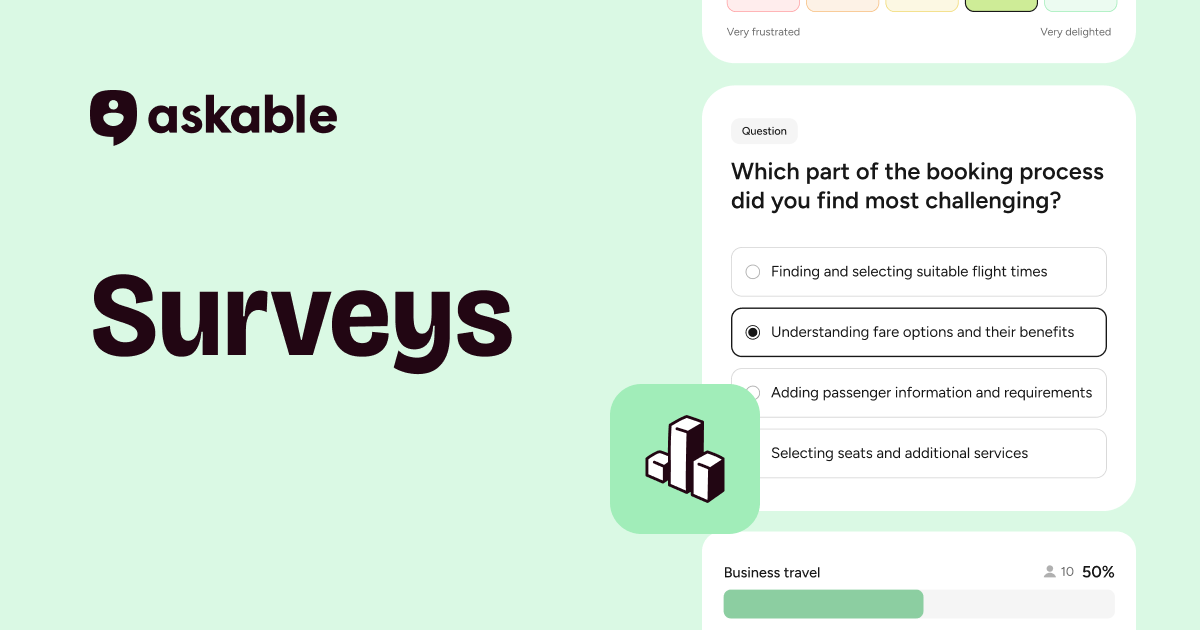
Contact salesAskable Surveys is designed to help teams gather both structured data and open text feedback effortlessly in a single platform. The experience begins with an intuitive survey builder that allows you to mix multiple choice questions, opinion scales, emotion indicators, and open text prompts in any order. This ensures that every survey captures both the numerical metrics you need and the deeper context that open responses provide. A visual logic builder shows exactly how participants will move through dynamic flows, making it simple to personalize questions based on earlier responses and deliver an experience that feels natural.
With Askable Surveys, capturing rich feedback at scale becomes significantly easier. Participants can express themselves in open text fields using their own words, and the platform’s AI automatically analyzes these responses to summarize key themes, detect patterns, and highlight sentiment across large datasets. This reduces manual effort and accelerates insight generation. Opinion scales with stars, numbers, or emojis allow for nuanced ratings, while structured options provide clean, comparable data. Every response type works together to give teams a complete picture of user sentiment.
Exporting insights is straightforward too. Askable Surveys provides presentation ready charts for quick reporting, raw CSV files for deeper analysis in tools like Excel or SPSS, and segmented insights that allow teams to explore differences across demographics or audience segments. This flexibility supports every type of research workflow, from lightweight reporting to in depth analysis. Because everything is stored in one place, teams can move fluidly between structured data and qualitative responses without juggling multiple tools or platforms.
One of the most powerful advantages of Askable is its global participant ecosystem, spanning more than 5,300 cities and more than 15 languages. With a verified community and a 97.8 percent show rate, teams can trust that their data is reliable and representative. Askable supports every major research method, including surveys, prototype tests, remote interviews, card sorts, tree tests, and AI moderated interviews. This creates a unified environment where teams can gather insights across multiple methods using the same trusted platform. By combining structured and open text data with global reach and advanced analysis, Askable Surveys helps teams generate richer insights at any scale.
If you want surveys that help you gather clear, structured data and deep open text feedback in one streamlined workflow, Askable Surveys gives you everything you need. Build dynamic flows, collect high quality responses, and turn participant feedback into meaningful insights that guide better decisions. Try Askable Surveys today and experience how unified survey feedback can transform your understanding of users.

.svg)



.png)

.jpg)
