AI Didn’t Make Us Faster... It Demoted Us
Christopher Nguyen
•
June 15, 2026
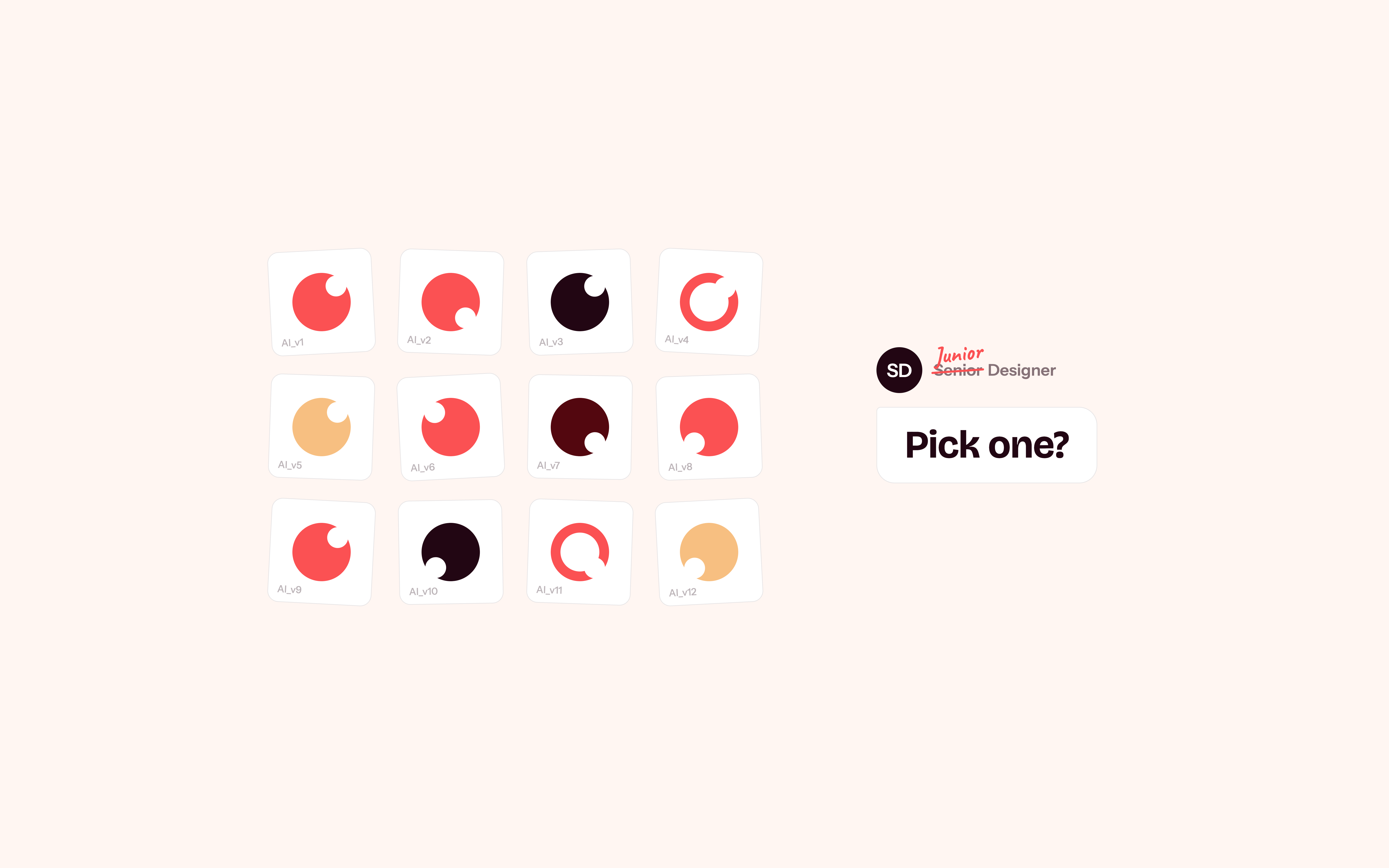

Logo, typography, color, the foundations of a visual system, animations, the website direction. All of it built for my new media company rectangles®. All in a few weeks with two designers and a stack of AI tools.
The output was genuinely good and I'm proud of what we made. But between reviews I kept catching myself with the same loop of doubt. Whether this was the right direction. What we were actually trying to say with the choices we were making. How the call we made today would lock us in six months from now.
Mid-review, I noticed something. My designers were walking me through variations without owning the why. Six moodboards. Five website directions. Four logos. “Chris, pick one”.
That's the exact move I made as a junior designer twelve years ago. Show every option you can produce, prove you can do the work, and quietly delegate the decision up the chain.
But these designers are not juniors. They are sharp, experienced, and brilliant. The speed of the work had put them in a junior posture. There was no room in the cycle for the why. Only the what.
This is what product teams everywhere are doing right now. AI didn't just make us faster. It compressed the gap between idea and artefact so much that the moments where someone normally asks "should we actually be building this" never got a chance to land. The artefact arrives before the conversation begins. Prototypes exist before briefs are finalized. Features ship before anyone has talked to a user.
Three forces collided, ensuring evidence velocity doesn't keep pace with product velocity.
Lovable, v0, Cursor, Figma Make. The effort to spin up a working prototype is essentially zero.
Fewer people, shorter timelines, more output to show investors and the board you're still moving.
Not Figma, but code. That part is genuinely exciting and a long time coming. It also teleported a lot of us back to the early-career instinct of doing more reps to master the new medium, because that's how humans learn anything.
The stack flattened. Anyone can design, build, and ship. Who’s asking whether we should or not?
The result is everywhere if you start looking. Studios now promise to deliver your brand and product in weeks, not quarters. AI startups raise on demos built in a weekend. Software is commoditised. Design is commoditized. The cost of building has dropped through the floor. Traditional research wasn't built to keep up.
We're building more, not better. We are not stopping to ask who actually wants this, whether anyone validated it, whether it is even a good idea. We are just shipping. And frequently the we're shipping the wrong thing.
I've noticed the teams doing it right are consciously adopting three things:
Tobi Lütke at Shopify writes about something he calls "learning on the shop floor." Every team gets access to the same AI agent in a public Slack channel, so the entire company is learning by osmosis from the same evidence. Centralized intelligence. Shared reasoning. Traceable evidence. One why that everyone can see and challenge. That's how you keep an organization honest when everyone is moving fast in their own corners.
Jenny Wen, now at Anthropic and previously Director of Product Design at Figma, talks about hiring "block-shaped" designers. Multiple core skills at the 80th percentile each, not one deep specialty. Her reasoning is that AI is eating the middle of every role. Pure executors get automated. Pure taste-havers become critics. The combination that survives this era is taste plus the ability to execute. Generalists with enough cross-domain context to point the whole system in one direction. The bottleneck moved from craft to integration, and hiring needs to follow.
Bill Gates wrote in his 2026 letter that we will need to be deliberate about how AI is developed, governed, and deployed. To anticipate problems. To build with foresight and care. That is the move. Not slower for slowness' sake. Shorter feedback loops on the reversible stuff, longer deliberate sessions on the strategic decisions. The what-ifs. The why-nows. The trade-off conversations. The customer realities. Speed up the small bets. Slow down the irreversible ones.
Strip all of this back and what has actually been knocked out of every workflow is the cheapest checkpoint there is. A real person, not on your team, telling you whether the thing you are about to ship matters. That's the why. That's the deliberate decision moment AI cannot manufacture for you. When I want a real check on a call my team is about to make, I use Askable. Verified research panel, 48-hour turnaround so it actually matches AI's tempo, 97.8% show rate, real users instead of fradulent participants.
But the tool is not the point. The discipline is. Put the human signal back into a process that has been running without it.

Chris is the founder of rectangles.fm and UX Playbook, helping designers shape their craft, careers, and calling through education and media. Previously a Head of Design, working with various startups and companies like Google, Nike, and 21st Century Fox.

.png)